
Amores Perros opening scene
- Dec 9, 2017
- 5 min read

Amores Perros is a film I have watched in my film class and I really enjoyed. I would recommend it to anyone that loves film as much as I do, since it is very smartly made. However, if you can’t stand bloody scenes I wouldn’t recommend it to you as there are several violent scenes of dogs fight with a lot of blood going on (but don’t worry no animals were harmed during the making of the film, as the director said). Here is my analysis of the opening scene.
The movie was made in Mexico in 2000 and it contains three stories, which are connected by a car accident in Mexico City that goes on to depict how the characters lives can change dramatically in that instant. Each of the three tales reflects the cruelty of humans towards animals and each other.Amores Perros concerns itself with the everyday navigation of life’s traps.
During the twentieth century, Mexico was experiencing an era of economic instability and a division of social classes. In Amores Perros the director portrays the distinction in the separation of the classes, and the effect of the economy on society. Daniel, Octavio, Susana, and El Chivo represent the three social classes in Mexico, the rich, the poor, and extreme poverty.
Alejandro Iñárritu is one member of a group of Mexican filmmakers often cited as the Three Amigos. They are seen as contributors to what has been deemed the ‘new wave’ of Mexican film.
Most filmmakers living in Mexico City have turned a blind eye to its problems but Gonzalez-Iñarritu broke the expectation that many people had with regard to their view of the future of Latin American cinema. Its braveness and boldness at showing reality of life in the city, served to shock and reveal to millions of people how modern-day life was in Mexico City and to critique a political situation that feeds the rich and abandons the poor. In 2000 a Hollywood movie called “traffic’ came out and part of it was set in Mexico, however it had Hollywood stars playing the leading roles giving an unreal sense of the film. What sets Amores Perros apart from other films that represent the city is that the characters are ‘real,’ and based on characters one would meet in the street.
Genre
The genre of Amores Perros is drama as it exhibits real life situations with realistic characters and settings. It also portrays the development of characters and contains conflicts between characters.
Alongside drama, the film is also a thriller as there are several conflicts between characters and the film contains the theme of crime.
The scene I will be analysing is the opening scene, which ends at the 5th minute. I chose to analyse this scene for a series of reasons. Firstly because it well establishes the mood of the whole film: frenetic, chaotic and dangerous through the use of camera movement and narrative. Secondly, this scene is important in terms of plot, as it is the moment when the three narratives link together by the car accident. And lastly because it presents the major themes of the film: violence, dogfighting, illegality and gender inequality.
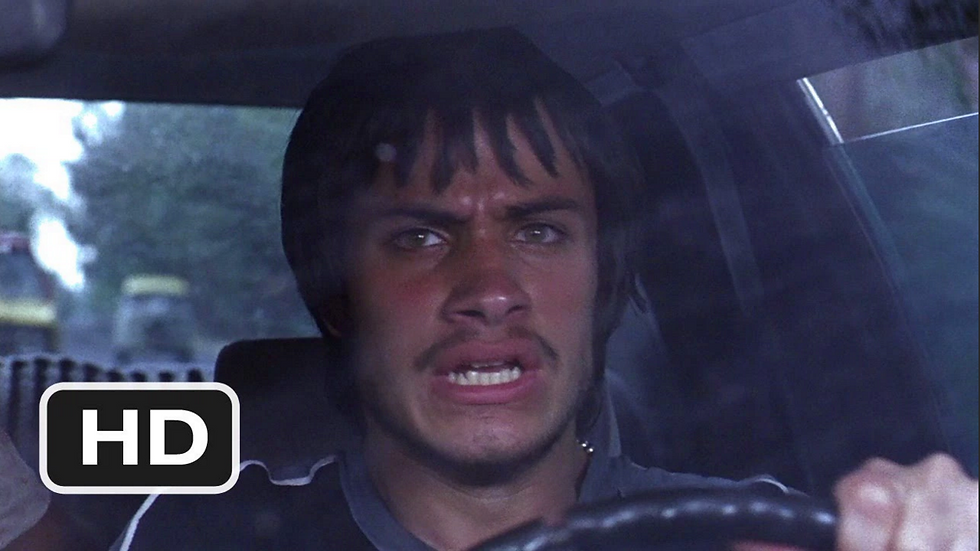
The chosen scene begins with a dog bleeding to death in the back seat of a car as it speeds through the streets of the city. The driver of the car and his passenger are screaming frantically at one another. The driver is Octavio, a working class guy who lives with his mother, brother and sister-in-law in a poor section of the city. In this opening scene he is heading towards a car accident, the event that ties together the characters in the three segments of the movie. After that, the first of the three tales “Octavio y Susana” begins. It begins with a scene of the dogfight introducing us the cruelty over animals and the violent society. After that we see Susana arriving home, opening the door and mistakenly letting Cofi, her husband’s dog, escape to freedom and causing the disequilibrium in the narrative. It is significant that Susanna doesn’t follow Cofi, instead resounds herself to the domestic space, entering back in the house. As the camera tracks in the apartment we see a photo of the pope on the wall, signifying the catholic culture of Mexico.

Narrative
The narrative of the film doesn’t follow a chronological order. The car accident comes later on in the story but was put in the opening scene as a flash-forward. The director made this choice to quickly break the equilibrium of the narrative and raise the audience’s interest into wanting to know more.
Non-diegetic narrative devices, such as titles, have been used in order to distinguish the three different tales of the film.

Audio
The audio in this scene and throughout the whole movie is mostly composed by diegetic sounds, like dialogues. Background music is rarely used enhancing the reality of the setting.
Lighting
During the whole sequence natural lighting is used. In the apartment scene it is obvious how the only source of light are the windows, which contrast with the dark environment of the house. The choice of using natural lighting conveys that the director didn’t want to give the scene a fictional look, rather a more realistic one.
Editing
The editing of the opening scene and throughout the whole film plays a major role. During the car chase scene the editing pace becomes increasingly faster, using fast cutting, which forbids the viewer from obtaining a real understanding of what they are seeing. Moreover, the order of the shots seems unorganized reflecting the confusion and fast-pace of city life. Furthermore, the fast editing builds up tension for the climax of the car crash that helps to take the audience by surprise when the accidents happens. Right after the car crash the editing pace becomes slower and the camera cuts to a shot of a women bleeding trapped in the car. This foreshadows a character, Valeria, which we will be introduced to in the second narrative.
Representation of characters
Amores Perros portrays a patriarchal society, where men are the ones with power, and women are associated to the domestic space. In the film women are represented mostly inside the house. Octavio’s mother is highly contained to the domestic space. She embodies the classic long suffering wife and mother, cooking feeding her ungrateful sons who provide her no money. As a character we never see her outside of the domestic space, not even outside the kitchen. Framing and composition devices trap her within the cluttered cramped working class home. Susanna is the clearest character who is most subject to the patriarchal machismo culture of Mexico. She can be seen to embody the Madonna/whore archetype that pervades Mexican culture and is a victim to an understanding of femininity as a dual construct, either mother or whore. Susanna is both a mother and highly desired sexual object. The only time she is outside the house she is seen as a “failed guardian of the hearth”, while she opens the door, allowing her husband’s dog to escape.
Camera composition
During the car chase the camera was hand held creating a shaky effect. This enhanced the chaotic moment as well as the fast movement of the car. The numerous close-ups of the two characters allowed them to express their feelings of fear of being shot by a gun.
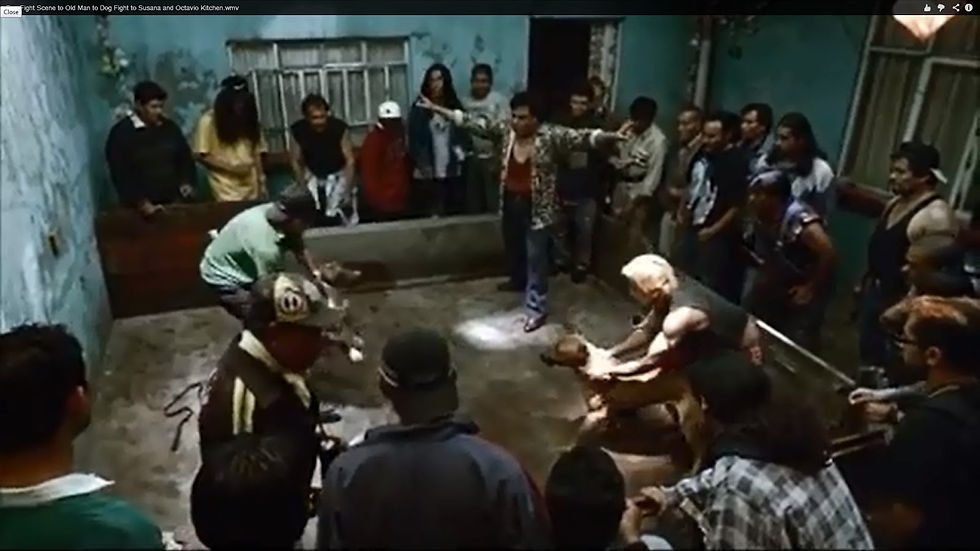
When we enter the dogfight environment the first thing we see is a low angle tracking shot of a dog making his way to the fighting platform and at the side we can see numerous dogs bleeding and trapped in cages. The camera is again hand held making the audience feel uncomfortable with what is seeing highlighting the cruelty toward animals.
Before the dogfight starts we have a series of close-up shots of money and alcohol showing how dogfighting was seen as an entertainment rather than an illegal activity.

Comments